For most of history, three generations lived within shouting distance of each other, often under the same roof. You didn't need to schedule a conversation with your mother about her childhood. You'd heard the story a dozen times before you were old enough to know it was a story.
That's not how most families live now. Grown children move for university, then for a job, then again for a partner's job. A parent in Vienna might have one child in Berlin and another in Toronto. The distance between generations has gone from zero to a few hundred, or a few thousand, kilometres. Phone calls fill some of that gap. They rarely fill in who your parent was before they were your parent. A personalised book for grandparents is one attempt to close that gap.
"Let's talk properly sometime" doesn't happen
Almost everyone means to have the real conversation eventually. Ask what their childhood felt like, what they wanted to do before life pointed them somewhere else, what they're quietly proud of that nobody has ever really asked about. Almost nobody does it, and it isn't because they don't care.
Sitting your father down and saying "tell me about your life" is a strange thing to do out of nowhere. It puts a weight on the moment that neither of you asked for. It can feel less like curiosity and more like an audit, or worse, like you suspect there isn't much time left. So the conversation gets postponed in favour of the version that's available: a fifteen-minute phone call about the weather and the grandchildren.
A personalised book for grandparents gives you permission to ask
What works is having a reason that isn't "I want to know you better." A reason that's more practical. "We're putting together a book about your life for the grandchildren" gives everyone a job. You're not interrogating your mother. You're helping her answer a set of specific questions for a specific purpose, and that reframing does most of the work.
It also breaks "tell me your whole life" into something answerable. Memolio's intake is around 40 questions, asked one at a time, specific enough that a concrete memory comes back rather than a summary: a decision you almost made differently, the first time you were truly on your own. Those are easier to answer across a kitchen table than "what was your life like," and they're exactly the kind of thing worth asking.
You don't need to write any of it down, either. The web form has a dictation option: your parent talks, and it's transcribed automatically. Which means the activity, for the person answering, is having a conversation, not filling in a form. You read the question out loud, listen to the answer, ask a follow-up. The way conversations usually go.
The second conversation happens during review
Here's the part that surprised me when I built this: the interview isn't the only conversation you get.
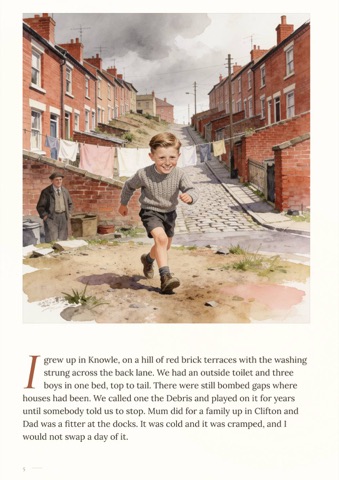
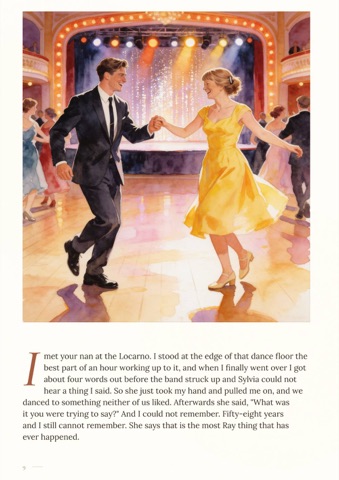
The AI takes 30 minutes to 2 hours to write the story and paint every page. That gap is usually treated as dead time, something to wait out. It's the second opportunity. Once the pages come back, you go through them together: the story it wrote from what your parent told it, the illustrations of scenes from their life. And because it's AI, it doesn't always land exactly right. A detail gets slightly embellished, or a scene looks like it's from the wrong decade.
That's not a flaw in the experience, even when it's a flaw in the render. Every "wait, that's not quite how it happened" is your parent correcting the record, which is another way of saying: telling you more of the story. You end up going back and forth over pages the way you'd go back and forth over an old photo album, except this time there's a reason to ask "so what did happen, then?"
What you end up with
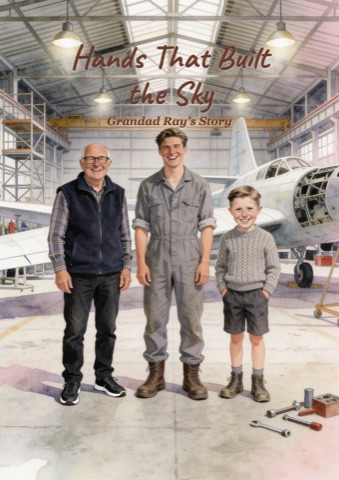
At the end there's a 24-page hardcover, illustrated, sitting on a shelf. Your kids can pull it down and ask about the grandparent in it. But the book isn't really the point, or not the whole point. The point is that you had two real conversations with your parent that you were never quite going to get around to otherwise, and a reason to ask again next year about whatever didn't make it into these 24 pages.
If your family is spread across three cities, or three countries, a personalised book for grandparents is one honest way to close some of that distance while there's still time to.